
Digital reality and consciousness
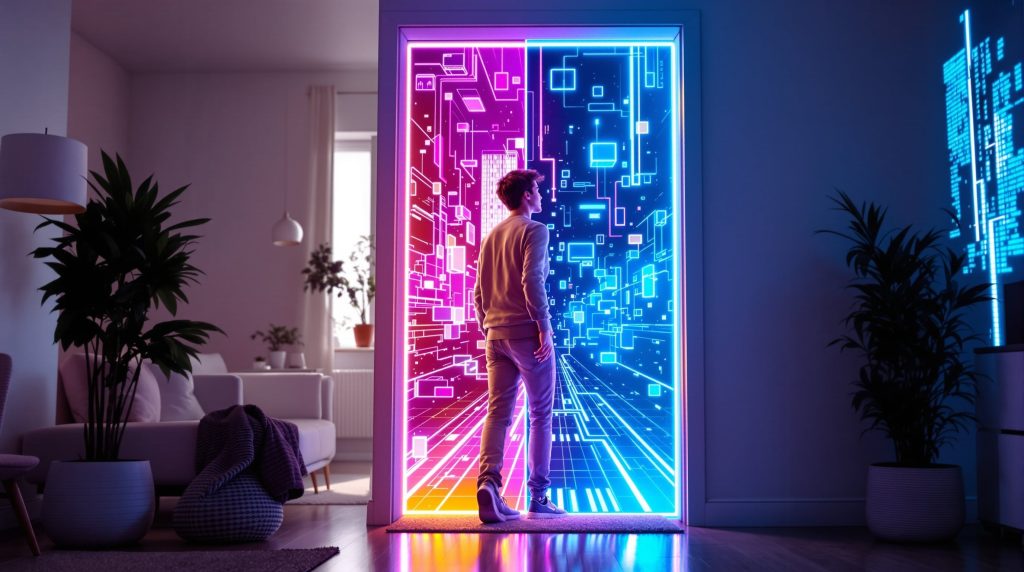
You’re sitting in your room. You put on VR goggles. And suddenly—you’re standing on a mountaintop, wind caressing your face, the sun setting in colors you’ve never seen in the “real” world. Your heart races. Your palms sweat. Your body reacts as if you’re actually there.
Then you remove the goggles and return to your room. Same walls. Same ceiling. But something has changed. You ask yourself—which of those two experiences was more “real”?
We live in an era where the boundaries between real and virtual worlds are blurring faster than we can comprehend them. Digital reality is no longer science fiction—it’s our everyday life. From Zoom calls replacing physical meetings, through VR meditations guiding us into inner worlds, to the metaverse promising a completely new dimension of existence—we stand on the threshold of a revolution that’s changing not just technology, but the very structure of our consciousness.
And that’s exactly what I want to discuss. Not from the perspective of a tech enthusiast selling the future, nor from a pessimist demonizing screens. But from the perspective of someone genuinely exploring what happens to our consciousness as we navigate between these worlds.
Because the question is no longer “is the virtual real?” The real question is—what does it even mean to be real?

💰 New income method is gaining attention
Discover how people are leveraging this system to generate consistent online earnings.
Explore now →
What You’ll Discover in This Article
- Digital reality and consciousness
- What digital reality actually is—and how VR, AR, and the metaverse differ
- How the evolution of virtual worlds led us to where we are today
- How digital reality affects your consciousness—from perception to emotions
- The phenomenon of presence and immersion—why virtual experiences feel “real”
- Psychological effects of virtual reality—research that will surprise you
- Who you are in virtual worlds—the question of identity in digital spaces
- How social connections are built (and broken) in digital environments
- The metaverse and the future of reality—where all this is taking us
- When virtual becomes “more real” than real—and what that means for you
- Escapism vs. exploration—the difference between healthy and unhealthy use
- Philosophical questions about the nature of reality—including the famous “Matrix question”
- Practical guidelines for conscious and healthy use of digital reality
- A personal story of my own journey through digital and inner worlds
What Is Digital Reality—VR, AR, and the Metaverse Explained
To understand how digital reality affects consciousness, we must first understand what it actually is. And no, it’s not just “that thing with goggles.”
Virtual Reality (VR) is complete immersion in a digitally created world. When you put on a VR headset, your visual and auditory systems receive information from an artificial environment. Your brain—and this is key—doesn’t make a complete distinction between VR stimuli and “real” stimuli. The amygdala reacts to a virtual height with the same dose of adrenaline as to a real one.
Augmented Reality (AR) is more subtle but equally transformative. AR doesn’t replace your world—it augments it. Pokémon GO was the first mass introduction to AR, but what’s coming—AR glasses indistinguishable from regular ones, constantly present digital layers—will fundamentally change perception of the world around us.
The Metaverse is the most ambitious concept—a persistent, shared virtual world where people live, work, and communicate through digital avatars. A vision of a completely new paradigm of existence.
But here’s what truly fascinates me: each of these technologies doesn’t just change what we see—it changes how we experience ourselves.

The Evolution of Virtual Worlds—From Dreams to the Metaverse
The idea of virtual worlds isn’t new. In fact, it’s as old as human consciousness itself.
Cave paintings from Lascaux, 17,000 years old, were the first “virtual worlds”—attempts to create an alternative reality on a cave wall. Shamans entering trances, visionaries “traveling” through inner worlds, ancient civilizations building temples as portals to other dimensions—all of this was a form of virtual reality, just without headsets.
In the modern age, evolution went like this: books created mental virtual worlds. Film added visual and auditory dimensions. Video games introduced interactivity. The internet connected everything. And VR completed the circle—returning us to the “cave,” but now with capabilities our ancestors couldn’t even imagine.
Second Life from 2003 was the first serious attempt at a mass virtual world. People built houses there, started businesses, even got married. Sound familiar? Twenty years later, the metaverse promises the same thing—just with better graphics.

💰 New income method is gaining attention
Discover how people are leveraging this system to generate consistent online earnings.
Explore now →What changed isn’t just the technology—the level of immersion changed. And with each new level of immersion, the boundary between “there” and “here” becomes thinner.
How Digital Reality Affects Consciousness
Here’s where things get truly interesting—and a bit frightening.
Neuroscientists have discovered something fascinating over the past decade: our brain processes virtual experiences using the same neural pathways as “real” experiences. When you stand on the edge of a virtual abyss in VR, your brain activates the same areas as when standing on the edge of a real abyss. Cortisol rises. Heart accelerates. Muscles tense.
This has profound implications for consciousness.
First, it means that our “reality” has always been a construct of the brain. What we experience as the “real world” is essentially a neural model—an interpretation of signals our senses receive. VR simply replaces the sources of those signals.
Second, digital reality can reprogram our mental patterns. A study published in the Journal of Cognitive Enhancement (2024) showed that people who spent 30 minutes daily in a VR environment designed for mindfulness, after eight weeks showed significant reduction in anxiety and improved focus—results comparable to traditional meditation.
Third, and this is deepest—digital reality opens questions about the very nature of consciousness. If the brain doesn’t distinguish virtual from real, where then is the “true” self? Does consciousness reside in the body, or is the body just one of the possible environments for consciousness?
These are no longer academic questions. These are questions we face daily as we navigate between screens and “reality.”

Presence and Immersion—Why Virtual Feels Like “Real”
In VR research, there’s a concept of “presence”—the subjective feeling of actually being “there” in the virtual environment. At the highest levels, people literally forget they’re in VR. Their consciousness completely relocates to digital space.
Mel Slater, leading VR presence researcher from the University of Barcelona, described the phenomenon of “place illusion.” Your body knows it’s sitting in a room, but your consciousness behaves as if it’s somewhere else.
If consciousness can be completely present in a space that doesn’t physically exist—what does that say about the connection between consciousness and physical location? Buddhists would say this confirms what they’ve claimed for centuries—that the physical world is illusion, maya, a construct of mind. VR demonstrates this on an experiential level.
Immersion is achieved through multiple channels—visual, auditory, haptic, even olfactory in advanced systems. The more senses engaged, the deeper consciousness “immerses” into alternative reality.
Psychological Effects of Virtual Reality
The psychology of virtual reality is one of the fastest-growing fields in contemporary science, and research results are often surprising—sometimes exciting, sometimes concerning.
Positive effects are significant. Research at Stanford showed that VR experiences where a person “embodies” an avatar of a different race or gender can significantly reduce implicit bias. Mirror neurons activate in ways that imagination alone cannot achieve. VR therapy for PTSD shows symptom reduction of 60-70%—because VR enables controlled re-experiencing of traumatic events in a safe environment.

💻 Build income from your laptop
More people are creating online income streams from home.
Explore now →But there are risks. “Derealization“—the feeling that the physical world no longer seems completely “real”—occurs in some users after prolonged VR stays. There’s also “VR hangover”—disorientation and feeling of detachment from the physical body that can last for hours.
The great paradox: technology that can heal trauma can also create it.
Identity in Virtual Worlds—Who Are We Online?
This question particularly fascinates me. In virtual worlds, you’re not limited to one body, one appearance, not even one gender. You can be anyone—or anything.
What research consistently shows is that avatars change behavior. This is called the “Proteus effect.” Nick Yee’s research at Stanford showed that more attractive avatars increase confidence, taller avatars increase aggressiveness in negotiations, and older avatars encourage thinking about saving.
Your avatar isn’t just a mask—it becomes part of your psychological identity. And this opens a deep philosophical question: if you can change identity by changing digital body, how stable is your “real” identity really?
Consciousness, as I understand it, isn’t a fixed point—it’s fluid, flow, process. Digital reality demonstrates this to us in a visceral way. We aren’t “one self”—we’re a constellation of possible selves, and virtual worlds give us space to explore them.
But there lies the danger too. If we over-identify with digital identity, we can lose contact with something deeper—with that level of consciousness that exists before any identity, before any avatar, before any role.

Social Connections in Digital Spaces
The COVID-19 pandemic was a global experiment in digital socialization. And we discovered something interesting: digital connections are simultaneously more and less than physical ones.
More—because they enable connection with people worldwide. A person with social anxiety can find a safe environment in VR. A person with disability can have a body that the physical world doesn’t allow.
Less—because digital communication loses “social presence.” Non-verbal cues, micro-expressions, physical touch—all of this is missing. That’s why we feel exhausted after long Zoom calls—”Zoom fatigue” is the result of the brain’s constant attempt to compensate for missing signals.
My stance is clear: digital connections are additions, not replacements. The root of human connection remains in physical presence—in that inexplicable feeling when you stand next to someone and sense their energy without words.
The Metaverse and the Future of Reality
The metaverse is the greatest promise—and the greatest risk—of the digital future.
Imagine a world where you wake up, put on AR glasses (that look like regular prescription glasses) and your physical world enriches with digital information. And for deeper experience, you put on a VR headset and enter a completely virtual space—work with colleagues in a virtual office, attend a concert, or meditate in a digital zen garden.
This isn’t science fiction. Meta, Apple, Microsoft, and Google are investing hundreds of billions in this vision. Apple Vision Pro is already here.
But let’s ask the key question: what happens to consciousness in a world where “reality” is optional?
When you can choose between the physical world (with all its limitations, pain, discomforts) and the virtual world (designed to be perfect, pleasant, exciting)—what do you choose? And what does that choice say about you?

When Virtual Becomes “More Real” Than Real
This is a phenomenon that simultaneously fascinates and disturbs me.
I know people—and I’ve experienced it myself—who’ve had experiences in digital spaces that felt more intense than everyday physical life. A virtual sunset that was more beautiful than a real one. A conversation with a stranger on the other side of the world that was deeper than conversation with someone sitting next to you. A sense of achievement in a game that was more vivid than achievement at work.
This happens because digital spaces are designed to engage consciousness. Every pixel, every sound, every aspect of interaction is optimized to hold attention, evoke emotions, create pleasure. The physical world doesn’t do this—it simply exists, indifferent to your experience.
And here arises a danger rarely mentioned in discussions about digital reality: not addiction to technology, but disappointment in physical reality. When you return from a brilliant virtual world to your average room, average job, average relationships—the physical world can start looking pale, boring, insufficient.
This is the same mechanism behind the problems with pornography—digital experience becomes so stimulating that real experience can no longer “compete.” And just as pornography redefined intimacy for an entire generation, digital reality threatens to redefine the very concept of experience for generations to come.
Escapism vs. Exploration—Healthy and Unhealthy Use
There’s a thin line between using digital reality as a tool for exploring consciousness and using it as an escape from reality. And that line isn’t always clear.
Escapism is when we use the virtual world to avoid something in the physical: pain, loneliness, boredom, responsibility. It’s reactive behavior—we run FROM something. Signs include: guilt after use, neglecting physical needs, worsening situation in “real” life, and irritability when you don’t have access to the digital world.
Exploration is when we use digital space as an extension of our experience, as a tool for growth, learning, creative expression. It’s proactive—we go TOWARD something. Signs include: feeling of enrichment, applying what’s learned in physical life, balanced time spent online and offline, and ability to stop without difficulty.
Same tool—completely different dynamic. VR meditation can be a deeply transformative practice, or a sophisticated form of avoiding real inner work. The metaverse can be a space for creative expression or a gilded cage.
The key to differentiation is awareness of intention. Why am I entering this space? What do I want to gain? Does this serve my growth or my comfort? These questions are simple, but require honesty we rarely practice.
Consciousness in Digital Spaces—A Deeper Perspective
Let me delve into something that will sound radical, but I think is fundamentally important.
The more I study the relationship between consciousness and digital reality, the more I come to conclude that the very concept of “digital vs. real reality” is wrongly framed. Because we observe the problem from the assumption that there’s one “true” reality, and everything else is imitation.
But what if every reality—including this physical one—is just one of many possible frameworks for the experience of consciousness?
This isn’t just philosophical speculation. Quantum physics tells us that at the most fundamental level, “matter” doesn’t exist the way we imagine it. Particles are probability waves that “collapse” into a certain state only when observed. In other words—physical reality at some level depends on the consciousness observing it.
If that’s true, then VR isn’t “fake” reality—it’s simply another framework in which consciousness can have experience. Not less “real,” just different.
Of course, there’s a key difference: consequences. In physical reality, if you jump off a building, you die. In VR—you reset. And that difference in consequences is what gives physical reality its weight, its seriousness, its invaluable value for spiritual growth.
Because growth doesn’t happen in comfort. It happens in friction, in challenge, in facing what you cannot control. And that’s something virtual reality, no matter how advanced it becomes, can never fully replicate.

Philosophical Questions About Reality—And the Matrix Question
We inevitably arrive at the oldest philosophical question, which Keanu Reeves made famous: What is real?
Plato described the “Allegory of the Cave” 2,400 years ago—imprisoned people who consider shadows on the wall the only reality, unaware of the world outside the cave. VR has made this allegory literally demonstrable. Put someone in VR long enough—and the physical world becomes that “outside” yearned for.
René Descartes wondered if there was a demon creating an illusion of reality for him. Today we could reformulate that: are we already living in a simulation? Nick Bostrom from Oxford formalized the “simulation argument”—and mathematically showed it’s statistically more likely we’re living in a simulation than in “base” reality.
Zen Buddhism offers a different perspective: the question “what is real?” is the wrong question. Instead, ask: “Who is asking?” Because the only thing that’s undoubtedly real is the very consciousness posing that question. Everything else—physical, digital, imaginary—are just different forms that consciousness takes.
And there, believe it or not, technology and spirituality meet. VR shows us the plasticity of perception. Meditation shows us the depth of consciousness behind perception. And wisdom lies in the ability to hold both insights simultaneously.
Grounding in Physical Reality
As fascinating as digital reality is, the physical world remains our home—at least for now.
And here lies the paradox of modern life: the more time we spend in digital spaces, the more we need conscious grounding in the physical. Not because digital is “bad,” but because our nervous system, our body, our biology—all evolved for the physical world.
Practically, this looks like: after a VR session, spend at least 15 minutes in conscious contact with physical environment. Feel the ground under your feet. Touch the texture of the wall. Breathe air consciously. This isn’t esotericism—it’s neural recalibration. Your brain needs time to “return” from virtual mode, and conscious engagement of senses accelerates this process.
There’s a practice I’ve called “digital pivot”—every time you transition from digital to physical world (or vice versa), make a conscious pause. Three conscious breaths. Become aware of where you are. Become aware of what you feel. Become aware of the transition. This sounds simple, but transforms the experience because it prevents that automatic, unconscious “zombie” navigation between worlds.
Conscious Engagement with Virtual Reality
Mindfulness and VR are, at first glance, opposites. Mindfulness brings us back to the present moment, to the body, to immediate experience. VR takes us from physical space into a constructed world. But this opposition is superficial.
True mindfulness isn’t tied to physical body—it’s tied to quality of attention. You can be completely non-present while sitting in the most beautiful forest, and completely present while in VR meditation. What counts isn’t the medium—but awareness.
Several principles for mindful use of digital reality:
Before entering—set intention. Why are you entering? What do you want to experience? This isn’t a rigid plan, but focused attention.
During experience—periodically check: am I aware I’m in VR? Do I notice my bodily reactions? Am I “lost” in content or consciously participating?
After exiting—reflect. What did I learn? How do I feel? What can I apply in physical life?
This transforms every VR experience from passive consumption to active practice of awareness. And that is, I believe, the key to healthy integration of digital reality into our lives.

Benefits of Digital Reality for Consciousness Expansion
Despite all the risks, digital reality offers something we’ve never had before: access to experiences that expand consciousness in ways that are physically impossible.
You can “become” a tree in VR and experience the world from its perspective—and research shows this significantly increases ecological awareness. You can “embody” a person of different race, gender, or ability—and develop empathy that transcends intellectual understanding. You can visit reconstructions of ancient temples, meditate in digital spaces designed to optimize neural coherence, or even have experiences resembling altered states of consciousness—without any substances.
VR-assisted psychotherapy is an exponentially growing field. From treating phobias, through PTSD therapy, to helping people with autism develop social skills—practical applications are enormous.
But for me personally, the greatest benefit is epistemological: digital reality shows us that perception is a construct. And that knowledge, once you truly understand it—not intellectually, but experientially—changes everything. You begin to observe your “normal” reality with the same dose of curiosity and freedom with which you observe virtual reality.
Risks and Challenges
It would be irresponsible to talk about digital reality without honest reflection on risks.
Addiction is real. Dopamine is dopamine, regardless of source—and VR experiences designed for maximum engagement can create powerful addiction patterns.
Privacy and manipulation are enormous challenges. VR headsets track eye movements, micro-expressions, bodily reactions—data more intimate than anything social media ever collected.
Social isolation can paradoxically grow despite digital “connectivity.” Loss of contact with the body is a subtle but serious risk—the body isn’t just a “carrier for the brain,” it’s an integral part of consciousness.
And finally, existential risk: what happens to a society where large numbers of people prefer the virtual world? Who maintains infrastructure? Who cares for the physical world while everyone is “elsewhere”?
The Future—Where Are We Going?
The next ten years will be crucial.
VR and AR devices are becoming smaller, lighter, more powerful. Brain-computer interfaces (BCI) are moving from laboratories to commercial products—Neuralink is already testing implants for direct communication between brain and digital world. In the next twenty years, AR could become part of normal vision. In the next fifty, direct neural connections could make headsets obsolete.
My vision is optimistic, but conditional. With wisdom, these technologies can become the most powerful tools for consciousness expansion in history. Without it—we risk losing something essentially human.
Practical Guidelines for Healthy Use of Digital Reality
Here are concrete guidelines I’ve developed through my own experience and study of this field:
1. The 20-20-20 Rule: Every 20 minutes in VR, remove the headset for 20 seconds and look at something 20 feet (6 meters) away. This protects eyes but also “resets” perception.
2. Transition Journal: Keep a brief journal where you note how you feel before, during, and after VR experience. This develops metacognitive awareness of technology’s impact on your state.
3. Physical Practice as Counterbalance: For every hour spent in digital reality, spend at least half an hour in conscious physical activity—nature walk, yoga, exercise. The body must remain the center of your experience.
4. Digital Sabbath: One day weekly completely without screens and digital stimulation. This isn’t punishment—it’s reset. And you’ll notice how much richer you experience the physical world after a break.
5. Social Balance: Track the ratio of digital and physical social interactions. If you notice you increasingly prefer digital—that’s a signal for conscious re-balancing.
6. Intention Check: Before each entry into virtual space, ask yourself: “Am I entering toward something or running from something?” Be honest.
7. Set Time Limits in Advance: Decide how long you’ll spend in VR before putting on the headset. Set an alarm. Honor it.
Personal Story—My Journey Through Digital and Inner Worlds
I must share something personal, because this article without that element would be incomplete.
A few years ago, I was going through a period of intense inner questioning. Meditation was my primary practice, but I felt a plateau I couldn’t overcome. That’s when I first seriously stepped into VR—not as entertainment, but as an experiment with consciousness.
During one VR meditation, in an environment simulating floating in space—surrounded by stars, no ground under my feet—I experienced “liberation from spatial identity.” My consciousness expanded in a way that was simultaneously completely new and deeply familiar. As if I remembered something I always knew but forgot.
After that experience, I returned to meditation on the cushion with a completely different perspective. The physical space where I meditate is just one possible framework. The consciousness that meditates isn’t bound to that framework.
But I also went through a period of using VR as escape. Instead of facing difficult emotions, I would “flee” to the digital world. And I noticed how the physical world became gray, boring, insufficiently stimulating.
It took conscious decision to return. To accept the discomfort of physical existence. And that very decision—conscious choice of physical reality despite availability of perfect virtual—was the most important lesson.
Because you don’t choose reality because it’s better than virtual. You choose it because in its friction, in its limitations—something is hidden that no simulation can replicate: the authenticity of experiencing being that knows it’s mortal.
Deeper Insights About Consciousness and Reality
Consciousness is the only phenomenon in the universe for which there’s no consensus scientific definition. We don’t know what it is, where it comes from, or why it exists. And digital reality, in an unexpected way, illuminates this mystery.
Perhaps consciousness is like water—it takes the shape of the vessel it’s placed in. Physical reality is one vessel. VR is another. Dream is a third. In each, consciousness expresses differently, but consciousness itself remains the same—formless, unlimited, present.
Digital reality isn’t a threat to consciousness—it’s a new field for its manifestation. But the quality of experience depends not on the medium, but on the clarity of consciousness itself.
That’s why I believe the future isn’t in choosing between real and virtual—but in developing consciousness that’s clear and wise enough to move between worlds without losing itself. It’s the same skill mystics have developed for centuries—only now we have technology that makes it accessible.
Conclusion—A New Frontier of Consciousness
We stand on the threshold of a new era in human experience. Digital reality isn’t just a technological innovation—it’s a mirror in which we see the very nature of consciousness more clearly than ever.
The boundary between real and virtual is blurring, and we don’t have to experience this as a threat. We can see it as an invitation—an invitation to understand more deeply what it means to be conscious, what it means to “be there,” what it means to experience anything.
But this invitation demands something from us: awareness, responsibility, and wisdom. Technology will continue to advance regardless of our readiness. The question is whether we’ll advance with it—or be dragged, unconsciously, into a future we didn’t choose.
I choose conscious journey. And I invite you to join me.
Not in the digital world. Not in the physical world.
But in that space of consciousness that encompasses both—and transcends them.

Final Thoughts
As you read these words, your consciousness processes symbols on screen and from them creates meaning. This is, in its own way, already a form of virtual reality—black pixels on white background that in your mind become ideas, images, emotions.
The boundary between real and virtual has never been a solid line—it’s always been a spectrum. Digital reality just makes this more visible.
Your task isn’t to choose sides. Your task is to develop consciousness wide enough to encompass all sides—and grounded enough to never lose contact with what’s truly important: this moment, this body, this breath.
Because ultimately, the only reality that’s truly “real” is the one you consciously experience.
Everything else—whether physical world or virtual—are just different scenes on the stage of consciousness.
And you’re not the scene. You’re the stage.
With awareness between worlds
Frequently Asked Questions (FAQ)
Can virtual reality actually change our consciousness?
How safe is it to spend time in virtual reality?
Can the metaverse replace the physical world?
How do I know if I'm using digital reality in a healthy way?
Can VR and meditation be combined for deeper consciousness experiences?
Call to Action
If you found yourself in this text:
Register on the website
Share your experience in the comments
Write to us about your experiences during your life
Your voice can help others understand themselves.
With love and presence,
Miroslav Kiš/ Elion (facebook)
Technology and Mental Health: How the Digital World Affects Your Mind
The Connection Between Sleep and Body Energy – How Sleep Shapes Your Vitality
Patterns in the Matrix: Irrefutable PROOF We Live in a Hologram